Showing posts with label Quinta do Noval. Show all posts

Sunday, December 15, 2019

1991 port horizontal, 9th December

On Monday evening, G invited me to attend a gathering of the Port Forum, as he had organised a horizontal tasting of 1991 port. I made sure to drink plenty of water throughout the day beforehand, and successfully got myself to the Boot and Flogger. Although I was slightly early, several people were there already and glasses were being filled.

Ready for action!
There were 14 in attendance and 16 ports to taste, a formidable line-up. While I enjoy port, I don't have much of my own and what I do have isn't ready, so I'm not very au fait with how past vintages stack up, but it soon became apparent that 1991 was not held in high regard by the assembled company. One fellow guest spent much of the evening sighing and I could only conclude that his cellar was far more impressive. Still, for me, this was a very interesting experience and I enjoyed most of them.

The full line up
This was not in fact my first time attending the forum - a few weeks ago, I was invited by G to a smaller blind tasting where everyone brought a mystery bottle along. The take-home point for me that evening was that no two bottles of port, especially old port, are the same because their history and storage has a significant influence on what comes out of the bottle. Previously I had thought that if you drank say a Croft 1966 and then you drank another Croft 1966 they would be virtually identical, but it seems that's unlikely to be the case.


Returning to the 1991s, G was pleased to have found this bottle of Quinta do Noval Nacional going for less than the market rate in a famous wine shop in New York, of all places, and had arranged to get it shipped to D who had brought it over for this occasion. As I'm sure anyone who knows their port will know, this stuff is rare and commands an unusually high price, typically going for 10 times as much as other ports, so it's not often one gets to drink it. However, it failed to shine amongst the competition. For me it was accomplished and did have a lovely finish, but wasn't even in my top 5. G told me that this was from the "bad period" at Nacional, which perhaps explains it.


At the end of the evening we were each required to allocate six points between the wines, and the final scores are above. The scoring system seemed to end up giving disproportionately high marks to the top two wines, but it was clear that Croft and Taylor Vargellas were the winners.


I managed not to disgrace myself by getting my score in early and giving three points to the Croft. My notes say "this Croft is marvellous" and for me it had plums (high quality plums according to G), dark chocolate, liquorice and maybe even some leather. It was serious and less sweet than some, and we thought it would be fine for another 15 years.


Runner up was this Taylor's Quinta de Vargellas, which was classy, with prunes, dates and figs - I described it as panforte in a glass. It had a great finish. I didn't get much on the nose, possibly because I tasted it after the Cockburn Quinta Dos Canais, which was the main dud of the evening, with an extraordinary whiff of nail polish cleaner. "Genuinely undrinkable" said G.

Other honourable mentions go to the normal Noval which I liked although nobody else gave it any points, the Quinta de la Rosa and the Nieport.

All done!

This was a fascinating opportunity to try these wines side by side and thanks G for inviting me!

Sunday, July 22, 2018

Birthday dinner at the Savile, 20th July

On Friday evening, G and I had a joint dinner party at the Savile Club as we have both recently celebrated a moderately significant birthday. We held this in the Elgar Room upstairs, which was a very nice size for ten, and a random selection of ne'er-do-wells and miscreants were in attendance, otherwise known as family and friends.


On arrival we had a glass of this Champagne Billecart-Salmon Cuvee Nicolas Billecart 2002, which we tried in bottle earlier in the year. On that occasion, it went down in the blink of an eyelid, and I think it's fair to say that the same thing happened again. It was perhaps more austere in magnum than in bottle and with plenty of life to come, but had the same lovely floral notes. ‎I hope to drink some more in due course!


With the first course, we had this magnum of Chablis 1er cru Fourchaume-Vaulorent 2008 from Domaine Nathalie et Gilles Fevre. An old favourite from a great vintage, it had never been better. It was crisp and lemony, but with a breadth on the mid-palate that wasn't there when it was younger. it went really well with the sea trout. Sadly this was G's last bottle!


With our main course, a lamb tagine for the carnivores and a vegetarian one for the veggies, we had two reds. First, a magnum of Beaune 1er cru les Greves 2005 from Yves Darviot. This prompted much reminiscence about how we used to stay at Yves' house in Beaune back in the day etc.etc. The 2005s have taken a long time to come round but are getting there now. This had the classic violets on the nose and was very elegant. We have two magnums left and I would still not be in a rush to drink them!


The second red was a magnum of Chateauneuf du Pape Clos des Papes 1998 from Domaine Paul Avril. For me, this was richer and sweeter compared to the Beaune but was still not heavy. An impeccable mid-weight style of Chateauneuf, drinking perfectly now.

Beaune on the right, Rhone on the left


With pudding, we had a magnum of Rieussec 1983 - remembering from the famous 40th birthday dinner that one bottle of sweet wine is simply not enough! This was amazing, rich but with acidity that meant it was not in the least cloying. The marmalade element from the heavy levels of botrytis paired wonderfully with the lemon tart. G informs me that he has acquired three more halves to see if he can recreate the sensation.


It was an absolutely beautiful colour, too.


Then, with the cheese course, a real treat. G provided this Quinta do Noval Nacional 1960 which he acquired from an auction where they described it in the catalogue as "Da Silva 1960". Imagine his delight when this showed up. It was in great shape, still fairly dark in colour, and extremely complex on the palate, with notes of fig and prune and a certain creamy quality. The finish was extraordinary. Absolutely top notch vintage port. Thanks for sharing it with us, G.


And to round things off, we had a glass of Lemorton Vieux Calvados 1972, which was an excellent digestif with true essence ‎of apples.


All that remains is to say thanks to G for organising everything, to the staff at the Savile for looking after us so well, and to everyone who joined us - it was a really enjoyable evening. Now roll on the 50th in five years time!

Saturday, March 21, 2015

Quinta do Noval tasting, 19th March

On Thursday evening I attended a Quinta do Noval port tasting at the Perseverance in Marylebone, organised by ACC from the Burgundy Portfolio.


On arrival I was handed a glass of Coates and Seely Brut NV, which is an English sparkler from a vineyard in Hampshire. Apparently the blend of grapes is the usual trio - chardonnay, pinot noir and pinot meunier - but they also make a rose and a blanc de blancs. This one retails at £27.50 and I was impressed with it - it had a richness and complexity that reminded me of vintage champagne. The connection with Quinta do Noval is Christian Seely, who is the managing director (see Jancis article here).

I was also introduced to Corinne Michot, who was presenting the ports that evening. She had lots of great stories and was very entertaining to listen to. I'm not sure I should necessarily repeat everything she said!


Corinne started with an explanation of how port is made and told us that five grape varieties go into it. I lost track after touriga nacional, which was unfortunate as she told us we wouldn't get any cheese if we couldn't remember them all later! We also heard that the grapes for the vintage port are trampled by foot and that after three hours of this your legs are stained purple for the next two months. Where do I sign up?

The first port we tasted was the Noval Black, on the far left of the picture above. This is an entry-level port, with an easy-drinking style, and doesn't need decanting. It was perfectly nice and did the job it was designed to do.


Next up was this 2008 unfiltered Late Bottled Vintage port. This only costs slightly more than the Black (£19.50 compared to £17.50). It was described as being like a baby vintage port. I found it significantly more spirity on the nose.


Then it was on to this 2005 Silval vintage port. Corinne told us that Silval is a single vineyard on the estate. Here the alcohol was starting to mellow. Others thought it was quite light for vintage port, but 2005 wasn't a great vintage. It was interesting to try it.


Then we were on to the real deal, the 2012 vintage. Obviously this is very young but it's surprisingly approachable even now. Most port houses declared in 2011 rather than 2012, but Quinta do Noval declared in both. Apparently declaring in a different year from the competition is something they do quite often.

I enjoyed this very much and have already snapped some up for my cellar, although I'll have to be patient. ACC said it had a beginning and an end but was lacking in the middle at the moment - that would come with time. It was certainly far more nuanced than the previous ports, and you could taste wood, herbs and spices. Something to look forward to in my old age! Incidentally, Corinne told us that she's often asked when you should drink your vintage port, and "the answer depends on who I'm talking to". She advises opening a bottle a year to see how it's coming on. If only I had sufficient stocks to make that possible!

Come to mummy...

Finally, we tasted the jewel in the crown, the Nacional. We heard stories of restaurants where the sommeliers didn't understand the difference between this and the normal Quinta do Noval vintage port, and wished names would be named so that we could pay them a visit.

Corinne told us that Nacional is a small part of the vineyard where the vines are ungrafted, Most vines planted in Europe are grafted on to a phylloxera-resistant rootstock, but these aren't. Quite what that means in practice I'm not sure, except the proof is in the tasting. Admittedly I haven't drunk as much vintage port as some present who shall remain nameless, but this was undoubtedly the best port I've ever tasted.

It had a dark and intense nose with hints of liquorice, then on the palate it had an amazing silky texture and again great intensity. The finish went on for minutes. It was like port squared. The connoisseur next to me said that the fruit was closed and needed to relax, which I suppose it will with time. Certainly, when he said that, I immediately started tasting tight little currants. It had black fruits - blackcurrants and black cherries, and earthy flavours, and it also had a herbaceous quality - some said lavender and rosemary, whereas I detected mint which reminded me of my beloved Latour. Corinne said it's a baby and we all need to come back in 30 years. Power, complexity and elegance were all present in spades. I very much hope I get to try it again some day.


After that, we sat down to dinner. As usual at the Perseverance, the food was excellent - some duck rillettes to start, then guinea fowl and finally some stichelton and those lovely almost-shortcake oatcakes they do. To drink, we finished off the fizz and then moved on to this Cedro do Noval 2010 which is a normal red wine. It has some syrah in it and bore some similarities to a Rhone wine. "Good with sausages."

Sadly all the Nacional was gone by this stage of the evening

With the cheese, we had two tawny ports - a 20 year old tawny and a 2000 colheita which had spent 14 years in barrel. I found the 20 year old delicious with its dried fruits, almonds, orange peel and toffee. The vintage colheita was also great but possibly hampered by not being quite as ready to drink yet. The next day, G (who wasn't at the tasting) and I had a debate about whether the 20 year old tawny was the same as the William Pickering sold by AN Other merchant, but ACC confirmed that it's not the same blend. I'd love to try them side by side...


Towards the end of the evening, we had a surprise guest. This Rhodesian Ridgeback belonged to one of the owners of the Perseverance, and was quite magnificent.


All in all, it was a very enjoyable and educational evening, great to meet Corinne and her colleague Sam, and try these wonderful ports. The Nacional was an experience I won't be forgetting in a hurry. Thanks to ACC for encouraging me to attend!

Saturday, October 18, 2014

SPNS dinner, Tues 14th October

On Tuesday night, once again we gathered at the Savile Club for the next instalment of the Swiss Pinot Noir Society. To recap the rules, everyone is supposed to bring along a bottle which is not massively expensive but interesting.


I found the group sitting in the courtyard necking this Paul Pothelet champagne, provided by P. It wasn't familiar to any of us, but was apparently a grower champagne which had been bought in France after some sort of accident involving knocking over boxes in the shop (!) The consensus was that it made a good aperitif - zingy, fresh, light, floral, citrussy and generally gluggable.


Since there were seven of us present on this occasion, the fizz didn't last long so we moved on to my contribution, this Osborne Sibarita 30 year old oloroso, which I got from the Wine Society. Earlier on, G and I had debated whether this should be served as an aperitif or with cheese - in the end I think it was both!

It had an intensely nutty nose and was very dry with a great finish. Generally it went down pretty well, with the notable exception of T who decided it wasn't his thing at all - never mind eh... The chemist present detected tones of liquorice and acetone and there were comments that it would have benefited from some nibbles. It would probably have been perfect with a pecan nut or two, so I must file that idea away for future reference because I expect to order some more in due course. The WS also sell a 30 year old Palo Cortado from the same producer which may be the next thing on my hit list.


Then we moved upstairs where a host of goodies was waiting for us. With our starters we had this 2009 Bernkasteler Doctor Spatlese riesling from Wegeler provided by G, which he picked up at Frankfurt airport. For me this brought back happy memories of the Bernkastler Bratenhofchen which was an early purchase of mine, about 15 years ago, made by Deinhard (NB not to be confused with Die Hard).

The Bernkasteler Doctor vineyard is in the Mosel valley and is reckoned to be one of the best vineyards in Germany This wine was medium-sweet and I think everyone liked it. G got pears and apricots on the nose, while T's comments are hard to decipher even at this relatively early stage in the evening but seem very favourable. It went down easily and would have had a considerable future if we hadn't drunk it already. Memo to G: next time you're in Frankfurt airport, fill your boots!


Alongside this, we also drank this Chateau Ksara Sunset rose 2011, from the Bekaa Valley in Lebanon, provided by T who describes it as his favourite affordable pink and I could see why. It was aromatic - T said lavender, D got flower petals - very interesting and quite different from a normal rose. Good stuff, with a long finish.


With our main courses we had this Cote de Brouilly 2011 from Domaine du Chateau de la Valette also provided by P. This was considered good, with intense black and red fruit, but some felt that it might improve with age. 

We also had a red wine that I failed to take a photo of - sorry! This was from South Africa, La Vierge pinot noir 2011 provided by ACC. The failure to take a pic is particularly annoying as it had a striking label. I have found it on the internet instead:


ACC thought it was fantastic for a New World wine, and I don't think I'd have guessed it was New World if I'd been tasting it blind. It had good pinot style and reminded me of a Cote de Beaune burgundy. But it seems that once the bottle went round the table it received mixed reviews and there was a feeling that it, too, was perhaps on the young side. We like 'em old and mellow at the SPNS...


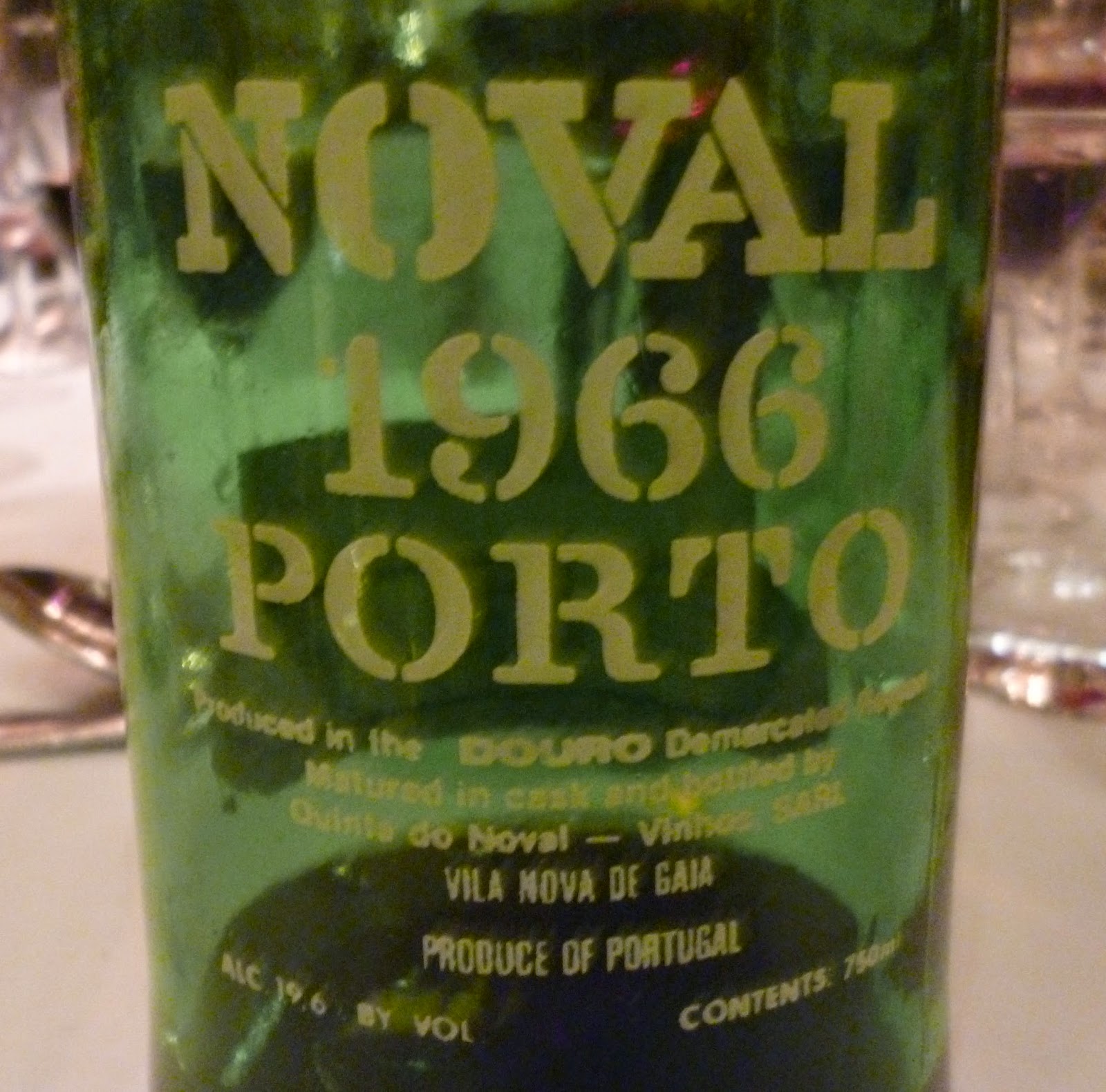
And that was what exactly we got with the last wine of the evening, this 1966 Noval tawny port bottled in 1984. It went down very well with the group, with descriptions of molasses and dried figs - it was sweet and smooth. G was particularly inspired at this stage and has written "Harris tweed with leather patches".


So there you have it, for those who read this blog to find out what they thought about things. We ended up sitting in the courtyard again with the aid of the snazzy heater activated by a red button on the wall, and the great snuff horn was brought out, before sadly being knocked over. I did take a photo of the carnage but it wouldn't be seemly to put it on a respectable blog like this. Shortly after that, we were marched inside to avoid further rowdiness, which was probably just as well.

This evening was particularly in the spirit of the SPNS, I think. Thanks everyone!

Saturday, December 04, 2010

Best of the Best tasting, 3rd Dec


For several years now my friend ACC has been holding a Christmas wine tasting which is always a major highlight of the year. We have a champagne, white burgundy, red burgundy, claret, sauternes and port, and throughout the year I know he spends a lot of time thinking ahead to this one and sourcing goodies for it.

Last night eight of us braved the icy pavements of Battersea to join him for this annual event and it proved to be a fascinating evening. Although I did take photos at the end they have come out very badly and I promise that one of my new year's resolutions is going to be reading the camera manual so that they're focused in future! (Obviously it had nothing to do with having too much to drink.)

First up, as an aperitif, was a magnum of Pol Roger 1990. This was fine, mature champagne. It was a golden colour and had yeastiness on the nose and richness on the palate. ACC said that 1990 was a difficult vintage for Pol as some of their grapes ripened faster than others. I thought this was the kind of champagne that makes you realise it's actually a proper wine but it didn't particularly set my world on fire, if I'm honest.

The second wine was a Chevalier-Montrachet "La Cabotte" Grand Cru 2000 from Bouchard. Grand cru is the top echelon of Burgundy and I don't get to drink it very often so this was exciting. It looked nice, and was a pale gold colour. The nose reminded me of the sort of big full-on Meursault that I like, and had a slight cabbageyness to it. But on the palate, I found it rather unbalanced and it had a sharpness as I was swallowing it that I didn't enjoy. Others observed that it didn't have the finish you'd expect at this level. Possibly it was too cold - the room where we were tasting was quite cold as it was -3C outside, and possibly it was just too young - there was some discussion of when it would be drinking, and whether it would improve over the next 2-3 years. I hope so. This wine goes for around £200 so while it was great to get to try it, there's no way I'd actually ever buy it.

Then we moved on to the reds. First a 1988 Clos-Vougeot from Capitain Gagnerot, another grand cru. My first impression of this wine was very favourable - it was a beautiful mahogany colour, had a rich, sweet nose with a pleasant "hint of the farmyard", and had chocolate and red fruits on the palate - I wrote down that it was (expletive deleted) delicious! Then the finish hit me, and I found it rather bitter. I tried to convince myself that it wasn't an unpleasant kind of bitterness but had to concede defeat. When we came back to taste it again later, the nose had become quite vegetal and it was fading fast. ACC circulated the copy of Bougougne Aujourd'hui with the map of Clos-Vougeot showing how it's carved up between the different growers and arguably the section owned by Capitain Gagnerot isn't one of the best. Still, this wine apparently goes for £100-150 so it's not exactly cheap.

The fourth wine of the evening was a 1990 Mouton Rothschild. Mouton's labels are always very artistic and in this vintage the label was by Francis Bacon. I was looking forward to this wine, and ACC told us that Robert Parker doesn't like it, which I think raised everyone's expectations around the table as Parker tends to like obvious, big, alcoholic wines at the expense of subtlety and elegance.

Again it was a beautiful dark red colour and very clear and scintillating in the glass. The nose was a delicious cabernet sauvignon nose, all cedar and lead pencils. So it was looking good - but then on the palate, there was just nothing going on of any interest. I charitably described it as "restrained" which in this case was a euphemism for dull. It did have a very good finish. But given the price of this wine (around £300), I think most of us found it disappointing.

Last year, in contrast, we had some Chateau Latour 1997 which was my wine of the evening. My tasting notes read "It does bring a smile to my face." Now, of course, I regret not buying any!

Fortunately things immediately improved with the sauternes. This was a 1975 Chateau Pajot, Enclave d'Yquem. ACC said that this vineyard is within the Yquem vineyard itself but is owned by someone else. It's extremely obscure and production is tiny, and 1975 was a great sauternes vintage. I liked it very much. It wasn't too sweet (for a sweet wine) and was very elegant, with a lot of citrus, marmaladey notes. I thought it was absolute nectar and it was my wine of the evening.

Finally, we had some 1966 Quinta do Noval vintage port. This had a very intense nose, with figs and dates both mentioned. It was a fine, classic port with a slight spiritiness. G described it as a "complete" port and it was his wine of the evening. If I hadn't been drinking my beloved Smith Woodhouse 1970 earlier in the day, I might have agreed...

All in all, a very interesting tasting and as is often the case, it was great to try some things one would normally never get one's paws on. On this occasion the most expensive wines didn't deliver. This has often been the case in the past too - at the top level there may sometimes be a step up in quality but the step up in price is exponential. Unless I win the lottery (unlikely as I don't play it) I'll stick to wines further down the scale and feel pleased that I'm getting good value for money.

One photo that did turn out all right - a genuine Tommy Seaward I spotted in the corner of the office. It reminds me of strawberry bootlaces and I love it!